
By David | Horry County Uncovered
For most of the last decade, the question on the Grand Strand was whether builders could keep up. Subdivisions spread through Carolina Forest, Longs and Socastee, and cranes stayed on the skyline. Now the market is losing steam, and a different question is coming up at county council meetings, on job sites and at kitchen tables: what happens to the thousands of immigrant workers, part of the Grand Strand’s immigrant workforce, who built all of it?
The answer matters to every Horry County resident, whether or not you have ever hung drywall. These workers frame the houses we buy, clean the hotel rooms that keep tourism dollars flowing, and pay rent, sales taxes and utility bills in our communities. Where they go next will shape home prices, construction timelines and the local economy for years.
Start with the numbers, because they are less settled than many people assume.
The official count is lower than the figure often repeated locally. Census Reporter’s profile of Horry County puts the foreign-born population at about 29,649, or 7.2% of residents, with a margin of error of nearly 5,000 [Census Reporter, 2024]. A separate tabulation estimated 25,600 foreign-born residents in 2024, about 6.7% of the county [Data USA, 2024]. Census ReporterData USA
Higher estimates exist. This outlet reported in 2025 that estimates of the immigrant population in Myrtle Beach and surrounding areas ranged from 30,000 to 60,000, with the legal status of those residents unknown [MyrtleBeachSC.com, 2025]. The gap is real, and it has a likely explanation: household surveys tend to undercount people who fear answering a government questionnaire. The true figure probably falls somewhere in that range. No one can pin it down precisely, and residents should be wary of anyone who claims otherwise. MyrtleBeachSC news
The makeup of the workforce is clearer. Researchers with the South Carolina Commission for Community Advancement and Engagement found that close to one in five Horry County construction workers is Hispanic, more than twice that group’s share of the overall population [WMBF News, 2026]. The same researchers found that a quarter of the working-age residents who have moved to the county since 2020 are Hispanic, which has helped counterbalance an aging local workforce [WMBF News, 2026].
Not every Hispanic worker is an immigrant, and not every immigrant is undocumented. But these figures show how much the local building economy depends on this labor pool.

The “cooling market” at the center of this question is real, but it is gradual.
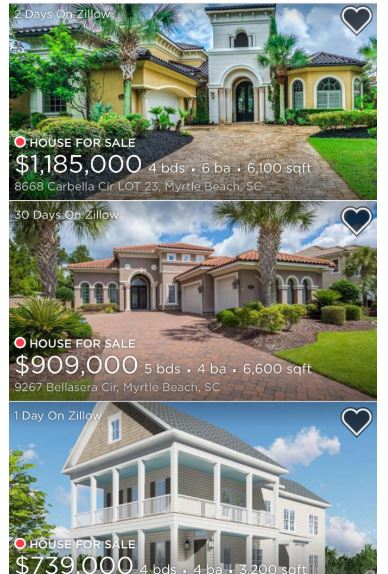
By mid-2026, Myrtle Beach showed classic buyer’s-market signals. Houzeo reported a median sale price of $322,700, down about 5% from a year earlier, with homes sitting for 85 days and more than six months of inventory on the market [Houzeo, 2026]. Closer to the beach, first-quarter data for the 29572 and 29577 ZIP codes showed closed sales up 5.4% while the median price slipped 2.3% to $537,000 [Myrtle Beach Herald, 2026]. HouzeoMyHorryNews
Local analysts describe a correction, not a crash. One Grand Strand brokerage’s review of regional numbers concluded that the data points to a rebalancing market rather than steep declines [Carolina Crafted Homes, 2026]. Another local forecast argued that steady in-migration gives the area a more stable demand base than markets that rely only on local economic cycles [Living in Myrtle Beach, 2025]. CarolinacraftedhomesLiving-inmyrtlebeach
The national picture points in the same direction, with a sharper edge for builders. Zillow found that residential permits nationally fell 1.7% in the year ending July 2026 and now run a record 19.4% below the pre-pandemic trend [Zillow, 2026]. PR Newswire
This matters for immigrant workers. Resale home prices do not employ framers or roofers. New construction does. A slowdown in permits hits construction crews directly, even when existing-home prices hold relatively steady.
One might assume a slowdown would leave immigrant tradespeople without work. The evidence suggests something more complicated: the industry was short on workers before the slowdown began.
WMBF reported that Horry County issued more than 3,600 residential permits in 2025, and local researchers told the station that few workers outside this group are willing to take on physically demanding construction jobs in the numbers needed [WMBF News, 2026]. Robert Fenton of the state commission put it plainly when talking about new housing and infrastructure: “Somebody has got to build them.” How Hispanic workers are keeping up with the Grand Strand’s growth +2
Nationally, the Associated General Contractors of America estimates that immigrants make up 35% of construction workers [Fortune, 2026], and the National Association of Home Builders reports that the share tops 60% in trades such as drywall, roofing and plastering [Construction Owners, 2026]. Yahoo FinanceConstructionowners
Here is the local analysis that often gets lost: a cooling market may reduce how much gets built, but it is unlikely to create a surplus of construction workers. If anything, it may simply narrow a shortage that was already there. Crews that once turned down jobs may now compete for them, but experienced tradespeople are still hard to replace.
Tourism is the region’s other big employer of immigrant workers, and it faces pressure of its own.
Federal data show leisure and hospitality employment in the Myrtle Beach metro swinging from about 46,200 jobs in August 2025 to 36,300 that December [U.S. Bureau of Labor Statistics via FRED, 2026]. That seasonal cycle means hospitality work alone rarely provides year-round income, which limits how many laid-off construction workers could shift into it. stlouisfed
The sector is also losing workers. In 2025, the owner of a Myrtle Beach immigration services firm told WBTW that Grand Strand hotels and restaurants were struggling with a shortage of cleaning staff tied to deportations and visa denials [WBTW, 2025]. Nationally, an American Hotel and Lodging Association survey found 76% of hotels operating short-staffed, with housekeeping among the hardest-hit roles [AHLA via Corbett Restaurant Group, 2026]. WBTWCorbettrestaurantgroup
Federal policy offers some relief on the legal side: in January 2026, federal agencies authorized about 65,000 additional H-2B seasonal visas for the rest of the fiscal year, effectively doubling the cap [Vanteo, 2026]. But those visas are for temporary workers brought in by employers, not for people already living here. Vanteo
If immigrant workers leave the Grand Strand in large numbers, the housing market may not be the main reason.
Nationally, immigrant departures are already happening at historic levels. Pew Research Center found that by June 2025 the U.S. foreign-born population had dropped by more than a million people, the first decline since the 1960s [Pew Research Center, 2025]. A more recent analysis from the Center for Immigration Studies, a group that favors lower immigration, estimated a 2.9 million decline in the foreign-born population between January 2025 and July 2026 [CIS, 2026]. Researchers at Brookings have cautioned that survey-based population estimates like these have flaws, and that other projections show far smaller changes [Brookings, 2026]. Key findings about U.S. immigrants | Pew Research Center +2
Enforcement also affects workers who stay. A National Bureau of Economic Research working paper found employment among likely undocumented workers fell 4% in areas with recent ICE raids, and 7.5% in construction [Fortune, 2026]. A Dallas Federal Reserve analysis described a chilling effect that makes people in immigrant communities more likely to miss work or avoid public places [Texas Public Radio, 2026]. Yahoo FinanceTexas Public Radio
Locally, ICE reports that the Horry County Sheriff’s Office is one of three departments in the state enrolled in its program, which it joined to identify and process immigrants facing criminal charges [WBTW via Yahoo News, 2024]. yahoo
The administration and its supporters argue that American workers can fill the gap. The White House has said there is no shortage of American workers to grow the labor force, and that its new Office of Immigration Policy will help employers navigate the rules [Axios, 2026]. Builders see it differently: in a recent survey, some homebuilders volunteered that immigration enforcement was straining their labor force, costs and construction timelines [Axios, 2026]. AxiosAxios
Putting these threads together, a few realistic scenarios emerge.
Workers with legal status are most likely to stay. Many immigrant tradespeople in Horry County have been here for years, own businesses, and have children in local schools. The WMBF profile of Costa Sur Construction, a company building homes across the Grand Strand since 2018, is a reminder that many of these workers are now contractors and employers themselves [WMBF News, 2026]. A soft market is a reason to adapt, not leave. wmbfnews
Mobile crews may follow the work. Construction labor has always moved toward active markets. If Grand Strand permits slow while other Southeastern metros stay busy, some crews will commute or relocate, as they did after the 2008 crash.
Enforcement will drive most departures. For undocumented residents, the calculation is less about mortgage rates than about risk. National data suggest that this, more than any housing cycle, explains why people are leaving.
Residents will feel it either way. Fewer workers means longer build times and higher labor costs, which get passed on to homebuyers and renters. For hotels and restaurants, it means thinner staffing during peak season.
The honest answer to “what will they do?” is that it depends less on Myrtle Beach real estate than on Washington. A cooling market trims demand for workers who were already in short supply. Federal enforcement, by contrast, removes workers regardless of demand.
For Horry County residents, the practical takeaway is this: if the region wants affordable housing, timely road projects and fully staffed hotels, someone has to do that work. Whether that labor comes from immigrants, visa programs or a new generation of local tradespeople is a policy choice with real price tags attached. Those are questions worth putting to county council, state lawmakers and our congressional delegation.
Grand Strand’s Immigrant Workforce – How Hispanic workers are keeping up with the Grand Strand’s growth — WMBF News
Grand Strand’s Immigrant Workforce – Horry County profile — Census Reporter
Grand Strand’s Immigrant Workforce – Horry County demographics — Data USA
Grand Strand’s Immigrant Workforce – Immigrant center coverage — MyrtleBeachSC.com
Grand Strand’s Immigrant Workforce – Myrtle Beach housing market 2026 — Houzeo
Grand Strand’s Immigrant Workforce – Q1 Myrtle Beach housing market — MyHorryNews
Grand Strand’s Immigrant Workforce – Is the Myrtle Beach market crashing in 2026? — Carolina Crafted Homes
Grand Strand’s Immigrant Workforce – The new home construction boom is running out of steam — Zillow via PR Newswire
Grand Strand’s Immigrant Workforce – Homebuilders struggle to find workers amid ICE crackdowns — Axios
Grand Strand’s Immigrant Workforce – Construction shortage and the immigration crackdown — Fortune
Grand Strand’s Immigrant Workforce – Immigration crackdown impacts Myrtle Beach tourism — WBTW
Grand Strand’s Immigrant Workforce – Leisure and hospitality employment, Myrtle Beach MSA — FRED
Grand Strand’s Immigrant Workforce – Key findings about U.S. immigrants — Pew Research Center
Grand Strand’s Immigrant Workforce – Total foreign-born down 2.9 million — Center for Immigration Studies
Grand Strand’s Immigrant Workforce – Macroeconomic implications of immigration flows — Brookings


